



 English
Freeze Drying News and Guides
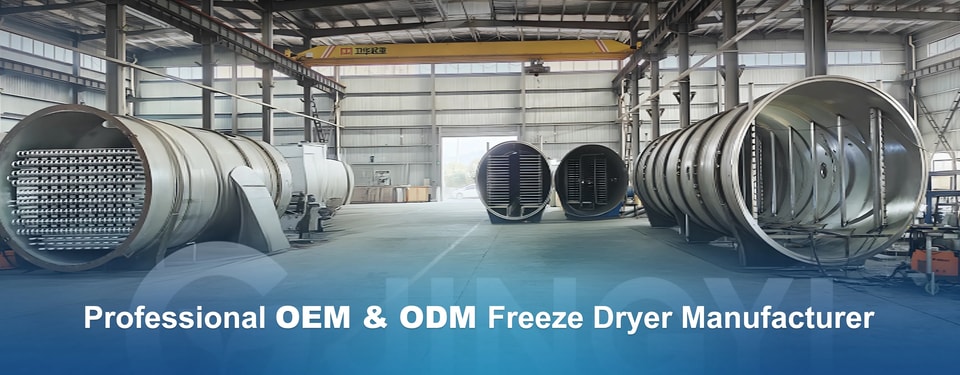
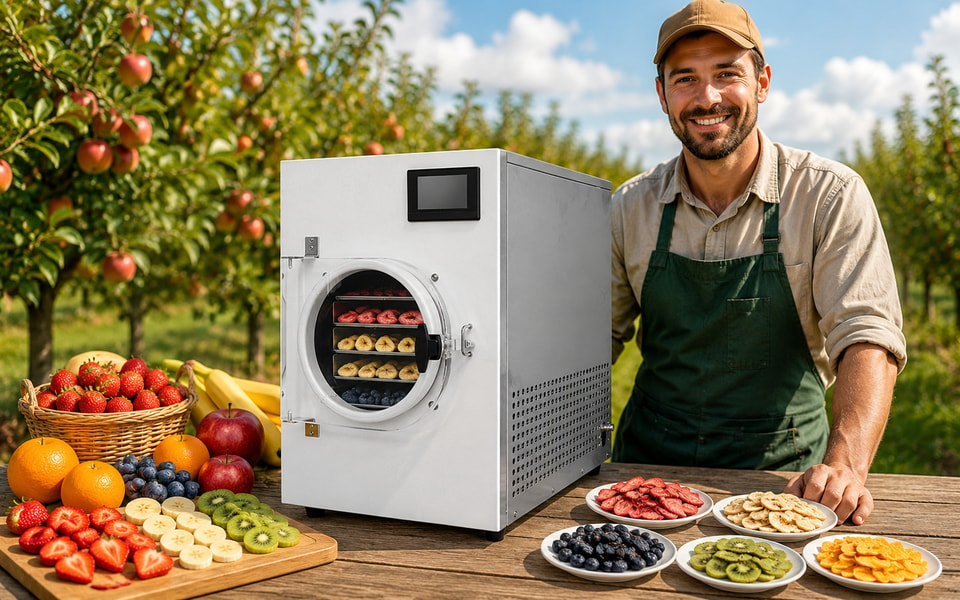
What Does a Freeze Dryer Actually Do? Freeze Drying Is Expanding Across Industries
Freeze drying is becoming more widely used across food, medical, laboratory, and production industries. It is valued for its ability to remove water while keeping product quality stable. As demand grows for longer shelf life and better product quality, more companies now use freeze dryers in their production processes. This technology helps maintain product structure, stability, and overall quality during drying. It is now considered an important method in modern preservation and processing systems. What Is a Freeze Dryer? A freeze dryer is a machine that removes water from a product using low temperature and vacuum pressure. It is also known as a vacuum freeze dryer or a lyophilizer. Unlike traditional drying methods that use heat, freeze drying works at low temperatures. This helps protect sensitive materials and keeps the product structure unchanged during the process. How Freeze Drying Works Freeze drying works in three main steps: freezing, vacuum drying, and final drying. In the first step, the machine freezes the product. Water inside the material turns into ice, which helps maintain the original structure. Next, the system creates a vacuum inside the chamber. Under low pressure, ice turns directly into vapor without becoming liquid. Scientists call this process sublimation. A cold trap collects the vapor and removes it from the system. In the final step, the machine removes any remaining moisture inside the product. This improves stability and helps extend shelf life. The final result is a dry, lightweight product that is easy to store and transport. Why Freeze Drying Is Important Freeze drying helps preserve product quality by working at low temperature. It protects the shape, color, and structure of the material. It also helps maintain natural properties that can be damaged by heat. Because of these advantages, many industries use freeze drying as a reliable preservation method. It offers stable results and consistent product quality. Applications of Freeze Dryers Freeze dryers are used in many industries. In the food industry, they are used for fruits, vegetables, meat, coffee, pet food, and ready-to-eat meals. These products remain stable and can be stored for long periods. In the medical field, freeze drying is used to stabilize sensitive materials that require long-term storage. It helps maintain product quality during transport and storage. In laboratory research, freeze dryers are used to preserve samples such as cells, enzymes, and tissue materials. This helps ensure stability for testing and analysis. Freeze drying is also widely used in plant and natural extract processing. It helps protect active ingredients used in health and cosmetic products. Types of Freeze Dryers Freeze dryers are available in different sizes to match different needs. Small systems are used for home applications and small-scale production. Laboratory freeze dryers are used for research and product testing. Pilot systems help companies test and improve production processes before scaling up. Industrial freeze dryers are used for large-scale manufacturing and continuous production. Each system plays an important role in different stages of product development and production. Technology Improvements in Freeze Drying Freeze drying technology continues to improve. Control systems are becoming easier to operate, and vacuum systems are more efficient than before. Energy performance is also improving with new system designs. These improvements help companies operate freeze drying systems more efficiently and with better stability. Growing Demand for Freeze Drying Freeze drying is gaining more attention as industries focus on product quality and long-term stability. Companies are looking for reliable preservation methods that can extend shelf life while maintaining product performance. With continued improvements in technology, freeze drying is expected to remain an important process in global manufacturing. Conclusion A freeze dryer removes water from products using freezing and vacuum technology. This process helps protect product structure, quality, and stability. Freeze drying is widely used in food, medical, laboratory, and industrial applications. As demand continues to grow, it remains a key technology for modern production systems. BOTH Instrument & Industrial Equipment provides laboratory, pilot, commercial, and industrial freeze dryer solutions. These systems support customers from product development to full-scale industrial production.
read more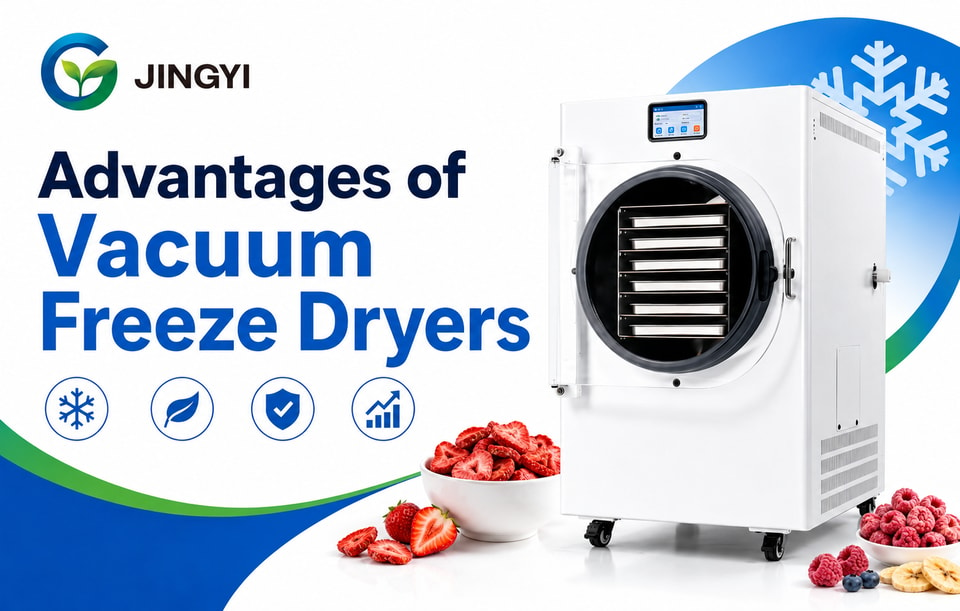
What Are the Advantages of Vacuum Freeze Dryers?
1. Introduction Vacuum freeze dryers are becoming a critical piece of equipment across the food processing, pharmaceutical, biotechnology, and high-value materials industries. As demand for high-quality dried products continues to grow, more manufacturers are focusing on the advantages of freeze-drying technology. Vacuum freeze drying works by combining freezing and vacuum sublimation to remove water while preserving the structure and activity of materials. This makes it one of the most advanced dehydration technologies in modern industrial production. Industry News reports show that the global freeze-drying equipment market is expanding steadily, driven by increasing demand for premium preserved products. 2. How Vacuum Freeze Dryers Work A vacuum freeze dryer operates through a three-stage process: pre-freezing, primary drying (sublimation), and secondary drying (desorption). First, the machine rapidly freezes the material to lock moisture into ice form. Then, under a vacuum environment, the ice sublimates directly into vapor without passing through a liquid state. Finally, residual bound water is removed during the secondary drying stage. This low-temperature dehydration process prevents thermal damage and helps maintain the original properties of the material. 3. Key Advantages of Vacuum Freeze Dryers 3.1 Maximum Preservation of Product Quality Vacuum freeze drying operates at low temperatures, which prevents the destruction of heat-sensitive compounds. Nutrients, proteins, flavors, and bioactive substances remain stable and intact. 3.2 Extended Shelf Life Freeze-dried products contain extremely low moisture levels. This inhibits microbial growth and significantly extends shelf life while reducing storage and transportation risks. 3.3 Excellent Structural Integrity and Rehydration The process preserves the porous structure of materials. As a result, freeze-dried products can quickly return to their original form when rehydrated. 3.4 Wide Industrial Applications Vacuum freeze dryers are widely used in food processing, pharmaceuticals, biotechnology, cosmetics, and laboratory research. Their application scope continues to expand as demand increases. 3.5 Higher Product Value and Market Competitiveness Freeze-dried products are positioned in the premium market segment. Manufacturers using freeze-drying technology can significantly increase product value and brand competitiveness. 4. Industry Applications Vacuum freeze dryers are widely applied across multiple industries: · Food industry: freeze-dried fruits, coffee, ready-to-eat meals, and pet food · Pharmaceutical industry: vaccines, antibiotics, and biological products · Biotechnology: enzyme preservation, microbial storage, and cell samples · Cosmetics: active botanical extracts and functional ingredients With the global health and convenience food trend, freeze-dried products are experiencing rapid market growth. 5. Scaling Up: From Lab to Industrial Production Vacuum freeze dryers are evolving toward larger capacity, automation, and intelligent control systems. Small-scale units are suitable for laboratories and startups, while industrial systems support mass production and continuous operation. Modern systems often include PLC control, multi-shelf temperature management, and remote monitoring to improve efficiency and process stability. Key factors in scaling up include production capacity, energy efficiency, and process consistency. 6. Equipment Solution In the vacuum freeze-drying industry, Shanghai Jingyi Tech Co., Ltd. provides a complete product range covering household, laboratory, pilot, and industrial-scale freeze dryers. The company focuses on integrated system design, including pre-freezing systems, vacuum systems, and cold trap technology. These integrated solutions help improve drying efficiency while ensuring stable product quality. Jingyi’s industrial freeze-drying systems are designed for food factories and pharmaceutical manufacturers that require scalable, reliable, and energy-efficient production equipment. 7. FAQ Q1: Why is vacuum freeze drying better than traditional drying methods?Vacuum freeze drying preserves nutrients and structure by avoiding high-temperature damage. Q2: Why are freeze-dried products more expensive?Because the process is longer and requires advanced equipment, but the product value is significantly higher. Q3: Is freeze-drying suitable for small businesses?Yes. Small and pilot-scale machines are available for startups and R&D use. Q4: Does freeze-drying consume a lot of energy?Energy consumption is relatively high, but optimized process control can reduce overall operating costs. If you are looking for a reliable vacuum freeze-drying solution, choosing the right equipment directly impacts product quality and business competitiveness. Shanghai Jingyi Tech Co., Ltd. provides end-to-end freeze-drying solutions, from equipment selection to full industrial system design, helping manufacturers upgrade production efficiency and product value. Contact the technical team to get a customized freeze-drying solution tailored to your industry needs.
read more
What Are Freeze-Dried Sweets and Why Are They So Popular?
Introduction In recent years, freeze-dried sweets have exploded across social media, retail shelves, and snack marketplaces worldwide. From crunchy freeze-dried Skittles to airy fruit candies, this new category of snacks is reshaping how consumers experience traditional confectionery. But what exactly are freeze-dried sweets, and why are they suddenly so popular? The answer lies in a combination of food science, texture transformation, and consumer demand for novel snack experiences. As vacuum freeze-drying technology becomes more accessible, manufacturers are using industrial systems such as modern freeze dryers to scale production while maintaining product stability and quality . What Are Freeze-Dried Sweets? Freeze-dried sweets are candies that have undergone a vacuum freeze-drying process, also known as sublimation drying. This process works in three main stages:First, the sweets are rapidly frozen so that all moisture inside turns into ice. Then, under a vacuum environment, the ice turns directly into vapor without becoming liquid. Finally, the remaining structure becomes dry, porous, and extremely light. This method is widely used in food and pharmaceutical industries because it preserves structure, flavor, and chemical stability far better than conventional heat drying . Unlike traditional candies, freeze-dried sweets become: · Crispy instead of chewy · Lighter in weight · Expanded in volume · More intense in flavor Common examples include freeze-dried gummy bears, marshmallows, and fruit candies. Why Are Freeze-Dried Sweets So Popular? 1. Unique Texture Experience The biggest reason for popularity is texture transformation. Freeze-dried sweets “pop” or “crunch” in the mouth, creating a sensory experience completely different from original candies. This novelty effect drives strong engagement on platforms like TikTok and Instagram, where ASMR-style food content is highly viral. 2. Enhanced Flavor Perception Without moisture, sugar and flavor compounds become more concentrated. This makes freeze-dried sweets taste stronger and more immediate, which many consumers find addictive. 3. Longer Shelf Life Removing water significantly reduces microbial activity. As a result, freeze-dried foods can be stored for extended periods when properly sealed, making them attractive for commercial distribution and export markets . 4. Health & Clean Label Appeal Many freeze-dried fruit sweets are marketed as having no added preservatives. Consumers increasingly associate freeze-drying with “clean” and minimally processed food, even when applied to candy products. 5. Social Media Virality Freeze-dried sweets are visually striking. Their expanded shapes, crackling sounds, and unusual textures make them ideal for short-form video content, which drives rapid consumer awareness. How Are Freeze-Dried Sweets Made? Industrial production typically relies on vacuum freeze dryers. These machines use low temperature and vacuum pressure to remove moisture while maintaining structure and color stability. Modern equipment allows manufacturers to control temperature, vacuum level, and drying time precisely, ensuring consistent batch quality across large-scale production lines . The process generally includes: 1. Pre-freezing the candy 2. Vacuum drying under controlled sublimation 3. Secondary drying to remove residual moisture 4. Packaging in moisture-proof materials Small-Scale vs Industrial Production Small-Scale (Home or Startup Use) Small freeze dryers are often used by hobbyists or boutique brands. They produce limited batches but allow experimentation with flavors and candy types. Industrial Scale Production Large commercial freeze dryers enable continuous production for supermarkets, export markets, and private-label candy brands. These systems prioritize efficiency, batch consistency, and energy optimization. Industrial models are essential for companies aiming to scale freeze-dried sweets into global snack markets. Equipment Solutions for Freeze-Dried Sweets Production For manufacturers entering this fast-growing market, selecting the right freeze-drying system is critical. Industrial freeze dryers offer: · Stable vacuum performance · Precise temperature control · Large batch capacity · High efficiency drying cycles · Food-grade stainless steel chambers These features ensure consistent product quality and compliance with food safety standards. Companies like industrial equipment manufacturers specializing in freeze-drying systems provide turnkey solutions for both pilot testing and mass production, helping brands quickly move from concept to market-ready product. FAQ Q1: Are freeze-dried sweets healthier than regular candy?Not necessarily. While some retain fruit nutrients, many freeze-dried sweets still contain high sugar levels. Q2: Do freeze-dried sweets melt or spoil easily?They are shelf-stable but highly sensitive to moisture. Proper airtight packaging is essential. Q3: Why do freeze-dried candies expand in size?Water sublimation leaves behind a porous structure, causing expansion. Q4: Can any candy be freeze-dried?Most water-containing candies can be processed, but high-fat or high-oil products may behave differently during drying. Q5: Is freeze-drying expensive?Yes, industrial freeze-drying requires specialized equipment and long processing cycles, which increases production cost. Freeze-dried sweets are more than a trend—they represent the intersection of food science, modern manufacturing, and consumer demand for unique sensory experiences. For businesses looking to enter this fast-growing market, investing in reliable freeze-drying technology is the key to consistent quality and scalable production. If you are exploring freeze-dried snack production or want to upgrade your manufacturing line, choosing the right industrial freeze dryer can significantly improve efficiency, product stability, and market competitiveness.
read more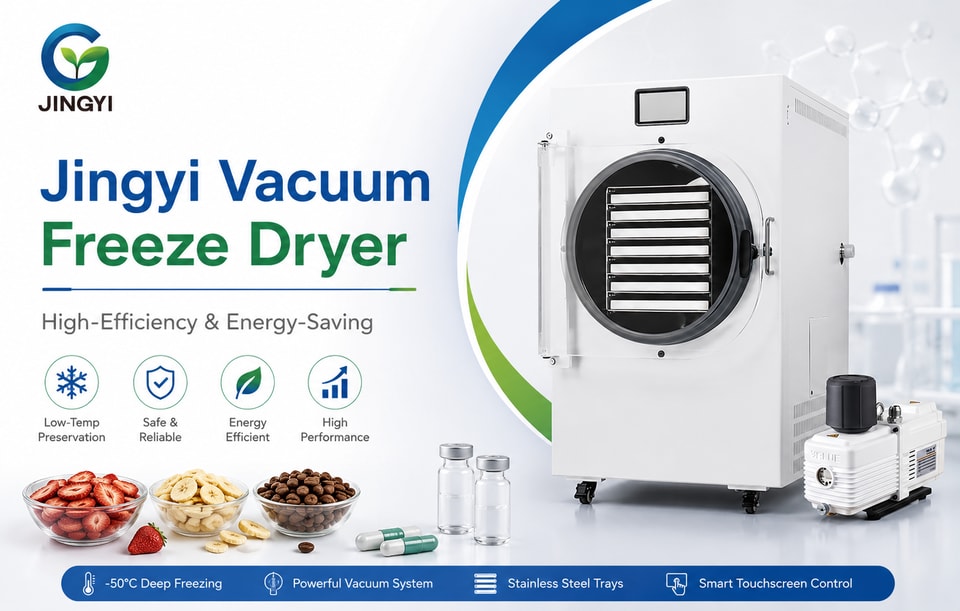
Jingyi Vacuum Freeze Dryer: High-Efficiency and Energy-Saving Freeze-Drying Equipment Manufacturer
1. Introduction The global demand for high-quality freeze-dried products continues to grow across food processing, pharmaceutical manufacturing, biotechnology, and premium consumer goods industries. In this trend, vacuum freeze dryers have become essential industrial equipment for preserving product quality while ensuring long-term stability. Shanghai Jingyi Tech Co., Ltd. positions itself as a high-efficiency and energy-saving vacuum freeze dryer manufacturer, focusing on delivering stable, scalable, and intelligent freeze-drying solutions for global customers. Industry News indicates that manufacturers are increasingly adopting advanced freeze-drying systems to improve product value, reduce processing risks, and meet stricter quality standards. 2. Company Background and Technical Strength Shanghai Jingyi Tech Co., Ltd. operates as a high-tech manufacturer specializing in vacuum freeze-drying technology. The company integrates R&D, design, production, and service into a complete industrial chain. The company develops freeze-drying systems based on controlled sublimation technology. It designs equipment that stabilizes temperature control, vacuum performance, and condensation efficiency. Engineers continuously optimize system architecture to improve drying efficiency and reduce energy consumption. The company also supports global customers with application guidance, process optimization, and technical consultation, which strengthens its authority and expertise in the freeze-drying industry. 3. Core Advantages of Jingyi Vacuum Freeze Dryers 3.1 High Efficiency Drying Performance Jingyi vacuum freeze dryers accelerate sublimation efficiency by optimizing cold trap design and vacuum stability. The system reduces unnecessary energy loss while maintaining drying quality. 3.2 Energy-Saving System Design The equipment integrates intelligent refrigeration control and staged heating systems. These technologies reduce power waste and improve energy utilization during long freeze-drying cycles. 3.3 Stable Vacuum and Temperature Control The system maintains stable vacuum levels throughout the drying process. It also controls shelf temperature precisely to ensure uniform drying results across all trays. 3.4 Wide Application Compatibility Jingyi freeze dryers process a wide range of materials, including fruits, vegetables, meat products, pharmaceuticals, enzymes, and biological samples. The system adapts to different moisture levels and material structures. 3.5 Industrial Scalability The product line covers household, laboratory, pilot, and industrial-scale models. This allows customers to scale production from R&D to mass manufacturing without changing core process principles. 4. Industry Applications and Market Trends Vacuum freeze-drying technology is expanding rapidly across multiple industries: · Food industry: freeze-dried fruits, instant coffee, and pet food · Pharmaceutical industry: vaccines, biological agents, and sensitive compounds · Biotechnology: microbial preservation and enzyme stabilization · Cosmetics industry: active ingredient preservation and plant extracts Market demand continues to rise as consumers prefer natural, additive-free, and long-shelf-life products. 5. Scaling Up: From Laboratory to Industrial Production Jingyi vacuum freeze dryers support a smooth transition from small-scale testing to industrial production. Engineers design modular systems that maintain consistent process logic across different capacity levels. Small units focus on flexibility and R&D testing. Industrial systems prioritize batch capacity, automation, and continuous stability. This scalable design helps manufacturers reduce transition costs and improve production efficiency. 6. Equipment Solution and Engineering Support Shanghai Jingyi Tech Co., Ltd. provides integrated freeze-drying solutions that include equipment selection, process design, and system configuration. The company combines vacuum systems, refrigeration units, and intelligent control modules into a unified engineering platform. This integration improves process reliability and reduces operational complexity. Technical teams also assist customers with parameter optimization, material testing, and production line planning, ensuring consistent freeze-drying results across different industries. 7. FAQ Q1: What makes Jingyi vacuum freeze dryers efficient?The system improves efficiency through optimized vacuum control and energy-saving refrigeration design. Q2: Can the equipment support industrial production?Yes. Jingyi provides pilot and industrial-scale systems for large-capacity manufacturing. Q3: Is the system suitable for sensitive materials?Yes. Low-temperature freeze-drying protects heat-sensitive compounds and biological activity. Q4: Does Jingyi provide technical support?Yes. The company offers full technical consultation from installation to process optimization. If your business is looking to improve product quality and expand into high-value freeze-dried markets, choosing the right equipment is critical. Shanghai Jingyi Tech Co., Ltd. provides high-efficiency and energy-saving vacuum freeze-drying solutions designed for modern industrial needs. Contact the engineering team to get a customized freeze-drying system tailored to your production goals.
read more
Is a Freeze Dryer Better Than a Dehydrator?
More People Are Comparing Food Preservation Methods More consumers and food producers want products that last longer. They also want to maintain quality without relying on large amounts of preservatives. As a result, many people are comparing freeze dryers and dehydrators before choosing a food preservation method. Both machines remove water from food, but they do so in different ways. These differences affect product quality, shelf life, texture, and overall value. Understanding how each system works can help users make a better decision. How a Freeze Dryer Works A freeze dryer removes water through freezing and vacuum technology. The process starts by freezing the product. The machine then creates a vacuum, allowing ice to change directly into vapor. Because the process uses low temperatures, it helps protect the original structure of the food. Many freeze-dried products keep their shape, color, and texture after drying. This is one reason why freeze drying has become popular in premium food production. How a Dehydrator Works A dehydrator removes water with warm air. Fans move heated air around the food until most of the moisture evaporates. This method is simple and has been used for many years. Many people use dehydrators for fruits, vegetables, herbs, and meat products. The equipment is easy to operate and usually costs less than a freeze dryer. For small-scale food processing, a dehydrator can be a practical option. Which Method Preserves Food Better? Product quality is one of the biggest differences between the two methods. Freeze drying works at low temperatures, which helps reduce damage during processing. Many freeze-dried foods retain more of their original appearance and structure. A dehydrator relies on heat to remove moisture. While this process is effective, heat can change texture, color, and flavor. For products that require higher quality preservation, many manufacturers prefer freeze drying technology. Shelf Life and Storage Performance Shelf life is another area where freeze drying often has an advantage. A freeze dryer removes a very high percentage of moisture from the product. With proper packaging, many freeze-dried foods can remain stable for years. Dehydrated foods also last longer than fresh foods, but they usually contain more remaining moisture. Because of this, storage periods are often shorter. For businesses that need long-term storage, freeze drying can offer greater flexibility. Cost and Production Considerations A dehydrator usually requires a lower investment. Most units are affordable, simple to operate, and suitable for basic drying applications. This makes them attractive for home users and small food businesses. A freeze dryer costs more because it uses refrigeration systems, vacuum pumps, and advanced controls. However, many companies accept the higher investment because freeze-dried products often command higher market value. The choice depends on production goals, budget, and product requirements. Growing Demand for Freeze Drying Demand for freeze-dried food continues to grow around the world. Consumers are looking for products that offer convenience, long shelf life, and high quality. At the same time, manufacturers want preservation methods that support premium products. These trends are driving interest in freeze drying technology. Food companies, research facilities, and product developers continue to invest in laboratory freeze dryers, pilot freeze dryers, and industrial freeze dryer systems. Which Option Is Better? There is no single answer for every application. A dehydrator offers a simple and cost-effective way to remove moisture from food. It remains a useful solution for many products and production environments. A freeze dryer provides better preservation, longer shelf life, and improved product quality. For businesses that want premium freeze-dried food products, freeze drying often delivers greater long-term value. Conclusion Both freeze dryers and dehydrators help preserve food by removing moisture. However, they achieve different results and serve different goals. A dehydrator offers a lower-cost solution, while a freeze dryer provides better product quality and longer shelf life. As demand for premium preserved foods continues to grow, more manufacturers are exploring freeze drying technology. BOTH Instrument & Industrial Equipment provides laboratory, pilot-scale, commercial, and industrial freeze dryer solutions that help customers develop high-quality freeze-dried products and scale production with confidence.
read more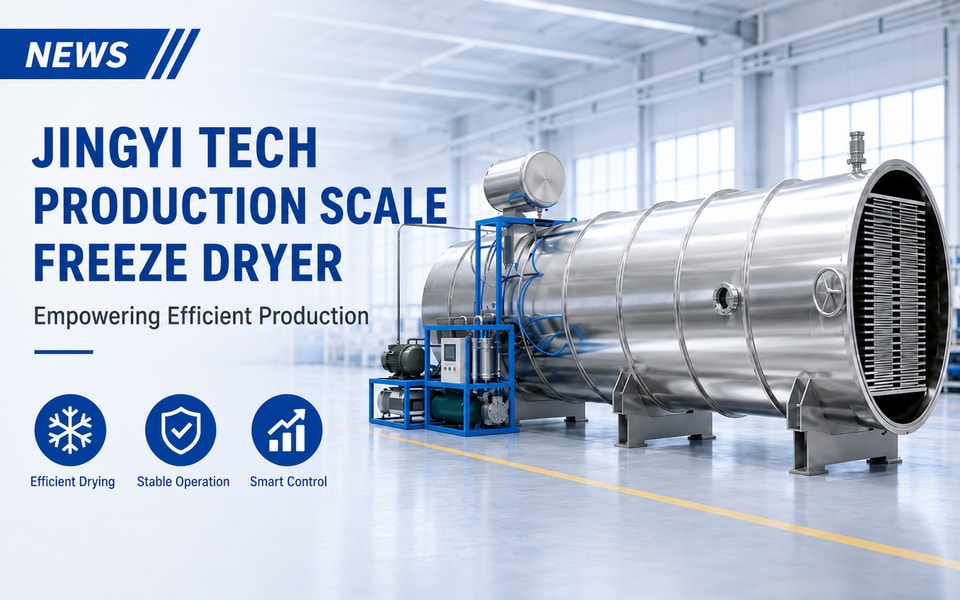
How to Choose the Right Freeze Dryer for Your Product?
Introduction Many buyers know they need a freeze dryer, but they are not sure whether a 20kg/batch machine, a 100kg/batch system, or a fully automated industrial freeze-drying production line is the right choice. This is one of the most common questions from overseas customers. Some companies start with a small freeze dryer for product testing, then quickly realize their production capacity can no longer meet market demand. Others invest in oversized equipment too early and face unnecessary operating costs. In reality, choosing the right freeze dryer is not only about machine size. It depends on your product type, moisture content, target output, production workflow, automation level, and future expansion plans. At Shanghai Jingyi Tech Co., Ltd., we often help customers compare different freeze-drying solutions before they invest in equipment. Our freeze dryers are widely used in food, pharmaceutical, biotechnology, cosmetic, and chemical industries. 一.Different Products Require Different Freeze Dryers Freeze-drying technology is suitable for a wide range of products because it removes water through low-temperature vacuum sublimation, helping preserve product shape, color, nutrition, flavor, and biological activity. 1. Food Industry Applications Food products are currently the largest freeze-drying application sector. Typical products include: · Fruits: strawberries, blueberries, mango, banana, apple · Vegetables: corn, okra, mushrooms, carrots · Meat products: chicken cubes, beef slices, seafood · Ready-to-eat meals · Pet food and freeze-dried treats · Instant coffee and specialty coffee · Yogurt cubes and snacks For food products, customers usually focus on: · Product appearance · Crunchy texture · Nutritional retention · Long shelf life · Production efficiency 2. Pharmaceutical & Biotechnology Applications Pharmaceutical and biotech materials require much stricter process control. Common applications include: · Probiotics · Vaccines · Enzymes · Biological products · APIs (Active Pharmaceutical Ingredients) · Herbal extracts · Cosmetic active ingredients For these products, stable vacuum control, shelf temperature accuracy, and clean production environments are especially important. 3. Other Specialized Applications Freeze dryers are also used for: · Flowers · Traditional herbal medicine · Chemical materials · Laboratory samples · Research materials Because different materials behave differently during sublimation, the freeze-drying process should always be matched to the product characteristics. 二.How to Choose the Right Capacity One of the biggest mistakes buyers make is selecting equipment only based on current production demand. A better approach is to evaluate: · Current batch output · Future business growth · Daily operating hours · Packaging requirements · Production efficiency goals Below is a practical selection guide. 1. Small Testing & Product Development (1–20kg/batch) This stage is suitable for: · Startups · New product development · Universities · Small workshops · Recipe testing Typical models include: · HFD series · RFD series · YFD series · SFD series These compact machines are popular because they: · Require less installation space · Have lower initial investment · Support recipe testing · Allow flexible operation 2. Commercial Production (20–100kg/batch) This range is suitable for: · Growing food brands · Coffee manufacturers · Pet food factories · Export-oriented businesses The VFD and SFD commercial series are commonly used at this stage. Customers at this stage usually start considering: · Faster cycle time · Stable product consistency · Multiple recipes · Continuous production scheduling 3. Pilot Scale & Process Optimization (50–200kg/batch) Pilot-scale freeze dryers are important before entering large industrial production. At this stage, companies usually: · Optimize freeze-drying recipes · Validate product quality · Test packaging solutions · Prepare for industrial expansion Pilot-scale systems help reduce production risks before investing in a large freeze-drying factory. Shanghai Jingyi Tech also provides pilot-scale freeze-drying testing services for customers who want to verify product performance before purchasing industrial equipment. 4. Industrial Mass Production (500kg/batch to Tons/Day) For industrial projects, freeze dryers become part of a complete automated production line. Typical industrial capacities include: · 500–750kg/batch · 1000–1500kg/batch · 2000–3000kg/batch · Multi-tons/day systems These large systems are widely used for: · Industrial fruit processing · Instant coffee production · Pet food factories · Seafood processing plants · Pharmaceutical manufacturing At this stage, customers usually focus on: · Automation · Energy efficiency · Continuous production · Labor reduction · Stable large-scale output 三.Typical Freeze-Drying Production Line Configuration A professional freeze-drying project is not just a single freeze dryer. A complete food freeze-drying line may include: Raw Material Cleaning → Peeling/Slicing/Dicing → Color Protection or Seasoning → Pre-freezing → Vacuum Freeze Drying → Sorting → Metal Detection → Weighing → Vacuum or Nitrogen Packaging → Carton Packing Different products may require additional processing equipment. Pet Food Production Line Pet food projects may include: · Meat grinding · Mixing · Forming · Cooking or sterilization · Freeze drying · Automatic packaging Instant Coffee Freeze-Drying Line Coffee processing usually includes: · Coffee extraction · Concentration · Pre-freezing · Freeze drying · Crushing and sieving · Packaging Pharmaceutical Freeze-Drying Line Pharmaceutical production lines may include: · Liquid preparation · Filling · Stoppering · Freeze drying · Clean-room packaging Think Beyond One Machine: Plan for Future Expansion Experienced buyers usually do not start by asking: “What machine should I buy?” Instead, they ask: “How can I build a scalable freeze-drying business?” A typical freeze-drying business expansion path looks like this: Laboratory Validation → Small Commercial Production → Pilot Process Optimization → Industrial Freeze-Drying Line → Automated Packaging & Capacity Expansion This approach helps companies: · Reduce investment risks · Improve product quality · Optimize operating costs · Expand production more efficiently Shanghai Jingyi Tech has specialized in freeze-drying technology since 2007 and provides complete freeze-drying solutions including freeze dryers, pre-treatment systems, quick freezers, and packaging systems. 四.Why Stable Freeze-Drying Technology Matters Many customers focus only on machine price at the beginning. However, long-term freeze-drying performance is much more important. A reliable freeze dryer should provide: · Stable vacuum control · Uniform shelf temperature · Efficient ice capture · Reliable refrigeration system · Easy recipe management · Data recording and export functions These functions become increasingly important as production scales up. 五.FAQ 1. How long does the freeze-drying process usually take? It depends on the material type, moisture content, thickness, and batch loading. Typical reference: · Fruits and vegetables: 12–24 hours · Meat and pet food: 18–30 hours · Pharmaceutical materials: 24–48 hours 2. What industries use freeze dryers? Freeze dryers are widely used in: · Food processing · Pharmaceuticals · Biotechnology · Cosmetics · Chemical industries · Research laboratories 3. Can freeze dryers be customized? Yes. Industrial projects are often customized according to: · Product type · Batch capacity · Factory layout · Automation requirements · Temperature and vacuum specifications 4. How do I know which freeze dryer model is suitable? The most important information includes: · Product type · Batch capacity · Daily production target · Product moisture content · Future expansion plans Once these details are confirmed, a suitable freeze-drying solution can be recommended. Contact Us for Freeze-Drying Solution Recommendations To recommend the right freeze dryer or complete freeze-drying production line, please tell us: · What product are you processing? · What is your target capacity, kg/batch or tons/day? · Are you planning industrial production? Our engineering team can help you evaluate the most suitable freeze-drying solution based on your production goals.
read more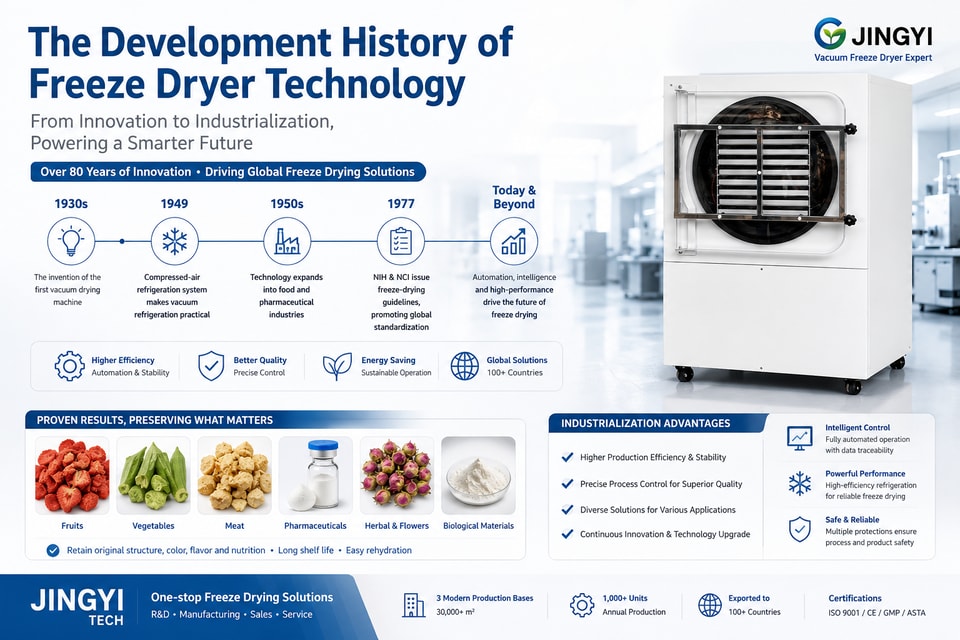
The Development History of Freeze Dryer Technology
Introduction With the continuous advancement of modern science and technology, freeze-drying technology has been widely applied and has become an indispensable part of modern industrial production. As an important method for preserving the original characteristics of food, pharmaceuticals, and other materials, freeze-drying technology is increasingly favored for its advantages of long-term preservation, portability, easy storage, and convenient rehydration. As the core equipment of this technology, the industrialization of freeze dryers represents a necessary step in the maturity and large-scale application of freeze-drying processes. 1. The Development History of Freeze Dryer Technology Freeze-drying technology originated in the late 19th century, when people began utilizing low-temperature preservation methods for food and pharmaceutical products. In the 1930s, American inventors Charles Foss and Stanley Puffer developed the first vacuum drying machine. Later, the technology was applied to processing fish products, and in 1949 Foss successfully developed a compressed-air refrigeration system, making vacuum refrigeration technology more practical and widely adopted. During the 1950s, with continuous technological improvements and material innovations, freeze-drying technology gradually expanded into the food and pharmaceutical industries. In 1977, the National Institutes of Health (NIH) and the National Cancer Institute (NCI) in the United States jointly issued the “Guidelines for the Preparation and Quality Control of Freeze-Dried Traditional Medicines,” which further promoted the adoption and standardization of freeze-drying technology worldwide. 2. The Significance of Freeze Dryer Industrialization As the core equipment in freeze-drying systems, the industrialization of freeze dryers aims to achieve equipment standardization, automation, and intelligent control to meet the demands of modern manufacturing. It improves production efficiency, operational stability, product quality, and market competitiveness, while also driving industry development. (1) Improving Production Efficiency and Stability Traditionally, freeze-drying processes relied heavily on manual operations, resulting in complex procedures, lower efficiency, and a higher risk of operational errors. With the advancement of modern freeze dryer manufacturing technology, automation has significantly improved. Today’s freeze dryers can achieve automatic control and intelligent production, ensuring stable and reliable operation while greatly enhancing production efficiency. (2) Enhancing Product Quality and Market Competitiveness As market expectations for product quality continue to rise, the freeze dryer industry has moved toward more precise and intelligent manufacturing. Through advanced control systems and optimized production processes, critical parameters such as drying pressure and temperature can be accurately controlled. This allows manufacturers to produce higher-quality products that better meet market demands while improving responsiveness to market changes and strengthening competitiveness. This development has had a positive impact on the quality and performance of products in industries such as food, pharmaceuticals, and biotechnology. (3) Developing New Freeze Dryer Technologies to Meet Market Demand With the continuous expansion of freeze-drying applications, market demands are becoming increasingly diversified. Manufacturers must continuously develop new types of freeze dryers that better suit evolving production and application requirements. The industrialization of freeze dryers provides the technical foundation and manufacturing environment necessary for this innovation. 3. Current Status and Future Trends of Freeze Dryer Industrialization At present, with the widespread adoption of freeze-drying technology and continuous improvements in freeze dryer equipment, the freeze dryer industry in China has already formed a solid industrial foundation. Both international and domestic manufacturers are actively participating in the market to capture greater market share. Meanwhile, several key trends are becoming increasingly evident. (1) Increasing Automation Traditional freeze dryers relied heavily on manual operation, which affected both efficiency and product consistency. Modern freeze dryers now integrate intelligent automation systems that allow users to accurately control key parameters such as temperature, pressure, drying speed, and safety protection. This greatly improves both productivity and product quality. (2) Development of High-Performance and Diversified Freeze Dryers As production demands continue to grow and application scenarios become more diverse, freeze dryer models are evolving rapidly. Modern freeze dryers are no longer limited to standard drying applications; they are now customized for different industries and specialized processing requirements, meeting users’ personalized production needs. (3) Continuous Optimization of Manufacturing Technology With the maturity of freeze dryer production technology, manufacturing processes continue to be optimized and upgraded. Modern freeze dryers not only focus on improved drying performance, but also emphasize energy efficiency, environmental protection, and intelligent operation to meet the needs of modern industrial production. Freeze Dryer Solutions from Shanghai Jingyi Tech Shanghai Jingyi Tech actively responds to changing market demands by continuously improving product innovation, manufacturing quality, and technological capabilities. As a professional manufacturer specializing in vacuum freeze-drying technology, the company provides comprehensive freeze-drying solutions for food processing, pharmaceuticals, biotechnology, laboratories, and industrial production. Our product range includes: · Household Freeze Dryers · Laboratory Freeze Dryers · Pilot-Scale Freeze Dryers · Industrial Freeze Dryers · Vacuum Packaging Equipment · Complete Freeze-Drying Turnkey Solutions With advanced automation systems, intelligent control technology, high-efficiency refrigeration systems, and customizable configurations, Shanghai Jingyi Tech helps customers improve product quality, production efficiency, and long-term operational reliability. If you are looking for a reliable freeze dryer solution for your business, research institution, or food processing project, Shanghai Jingyi Tech can provide professional equipment selection, customized system design, technical support, and global after-sales service.
read more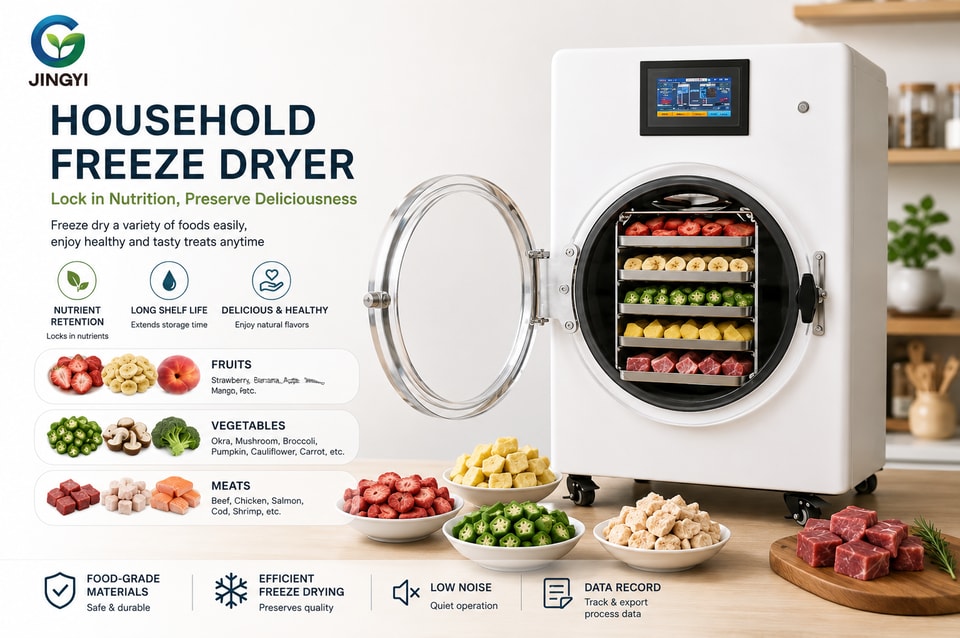
How Long Does One Freeze-Drying Cycle Take?
Freeze drying (lyophilization) is a process in which materials containing a large amount of water are first frozen into a solid state, and then the ice is directly sublimated into water vapor under vacuum conditions, while the material itself remains in the frozen structure. As a result, the product retains its original shape, becomes porous after drying, and experiences minimal shrinkage. During the freeze-drying process, the product temperature decreases as sublimation occurs, which slows the drying rate. To increase sublimation speed and shorten drying time, controlled heating is applied appropriately. The entire drying process is carried out at low temperatures. Before drying, the material always remains in a frozen state, and ice crystals are evenly distributed throughout the product. Because sublimation removes water directly from ice, there is no concentration effect caused by liquid water evaporation, thus avoiding side effects such as foaming, oxidation, or damage to heat-sensitive substances. Traditional drying methods such as sun drying, boiling, hot-air drying, spray drying, and vacuum drying are generally performed above 0°C or at even higher temperatures. Products dried by these methods often shrink in volume, harden in texture, lose volatile components, or suffer oxidation. Heat-sensitive materials such as proteins and vitamins may denature, microorganisms may lose biological activity, and the dried materials often become difficult to rehydrate. In contrast, freeze drying is fundamentally different. Most of the drying process occurs below 0°C while the product remains frozen. Only during the later stage, in order to further reduce residual moisture, is the product temperature gradually increased above 0°C, usually not exceeding 50°C. The entire freeze-drying process takes place under low-temperature and low-pressure conditions, effectively preserving heat-sensitive components and the original biological characteristics of the material. Since freeze drying is a gradual and carefully controlled warming process, excessive heating or rapid temperature increases may cause product collapse, poor appearance, or structural damage. The freeze-drying process generally consists of three stages: 1. Pre-freezing Stage 2. Primary Drying (Sublimation Drying) Stage 3. Secondary Drying (Desorption Drying) Stage Therefore, one complete freeze-drying cycle generally takes around 24 hours, although the exact duration depends on the product type. Materials with low eutectic points, such as biological products, may require 30 hours or more to complete the process.Whether you need a compact household freeze dryer, a pilot-scale unit for R&D, or a fully automated industrial freeze-drying production line, JINGYI can provide reliable equipment, technical support, and customized solutions tailored to your application needs
read more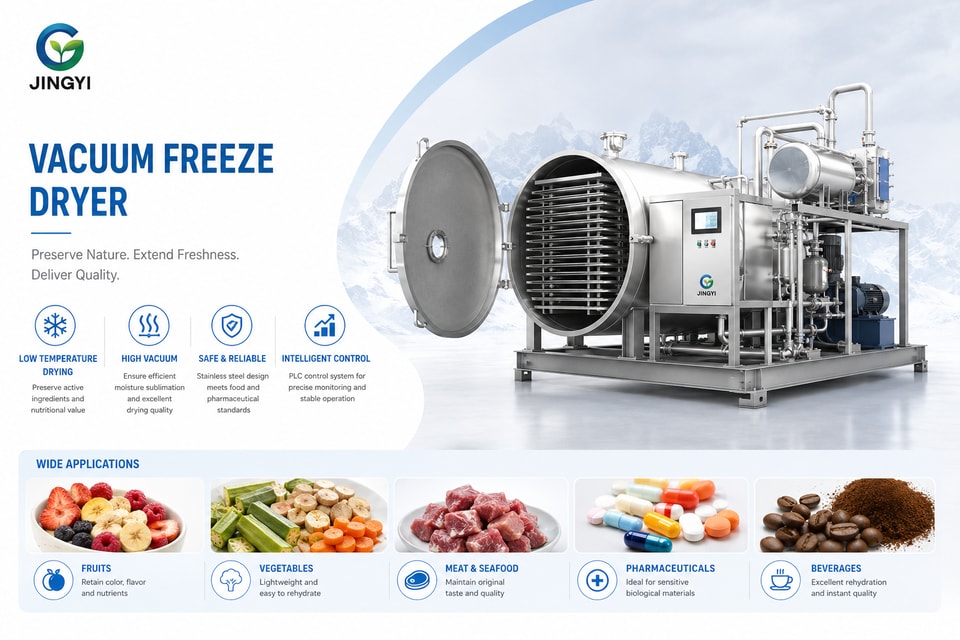
Freeze Dryer Capacity Guide: From kg/batch to Tons/day
Introduction As freeze drying technology continues to expand across the food, pharmaceutical, pet food, biotechnology, and nutraceutical industries, one question appears in almost every project discussion: How much freeze dryer capacity do I actually need? From small 3 kg household freeze dryers to industrial systems capable of processing several tons per day, selecting the correct freeze dryer capacity is one of the most important decisions for production efficiency, investment return, and future scalability. Whether you are starting a small freeze-dried fruit business, building a pet treat factory, or planning a pharmaceutical production line, understanding the relationship between kg/batch, batch cycles, and tons/day output is critical. Shanghai Jingyi Tech Co., Ltd. specializes in complete freeze drying solutions ranging from laboratory systems to large-scale industrial production lines. Understanding Freeze Dryer Capacity Freeze dryer capacity is usually expressed in three ways: · Kg per batch · Kg per 24 hours · Tons per day Each measurement reflects a different production perspective. 1. Kg/Batch This is the most common specification for freeze dryers. It indicates how much fresh material can be loaded into the machine during one freeze drying cycle. For example: · HFD-4: 3–5 kg/batch · HFD-10: 10–12 kg/batch · VFD-50: 60–75 kg/batch The actual output depends on: · Moisture content · Product thickness · Product type · Freeze drying recipe · Cycle duration 2. Kg per 24 Hours Industrial users often focus more on daily throughput rather than single batch loading. A freeze dryer with: · 50 kg/batch · 24-hour cycle equals approximately: · 50 kg/day fresh input However, if the recipe requires: · 36 hours per cycle then daily throughput decreases accordingly. This is why professional freeze dryer sizing must consider: · Product moisture · Sublimation speed · Cold trap efficiency · Heating system performance · Vacuum stability 3. Tons per Day Large industrial projects are usually planned around: · 500 kg/day · 1 ton/day · 5 tons/day · 10+ tons/day At this scale, capacity planning involves: · Multiple freeze dryers · Automated loading systems · Continuous freezing systems · CIP/SIP integration · Energy optimization Freeze drying becomes not just a machine purchase — but a complete production engineering project. How to Convert kg/batch into Tons/day The basic calculation formula is: Daily Capacity=Batch Capacity×24Cycle Time (hours)\text{Daily Capacity} = \frac{\text{Batch Capacity} \times 24}{\text{Cycle Time (hours)}}Daily Capacity=Cycle Time (hours)Batch Capacity×24 Example Calculation If your freeze dryer processes: · 100 kg/batch · 20-hour cycle Then: 100×2420=120 kg/day\frac{100 \times 24}{20}=120\ \text{kg/day}20100×24=120 kg/day Which equals: · 0.12 tons/day Typical Capacity Ranges by Freeze Dryer Type Household Freeze Dryers Designed for: · Home food preservation · Small startups · Product testing · E-commerce freeze-dried snacks Typical capacity: · 1–20 kg/batch Examples from Jingyi HFD and RFD series include: · HFD-1: 1–2 kg/batch · HFD-8: 8–10 kg/batch · RFD-15: 15–20 kg/batch These systems offer: · Compact footprints · Easy operation · Automatic freeze drying programs · Low energy consumption Pilot-Scale Freeze Dryers Suitable for: · R&D institutions · Trial production · New product development · Small commercial factories Typical capacity: · 20–100 kg/batch Pilot systems help manufacturers: · Optimize recipes · Validate drying parameters · Test market demand before scaling up According to Jingyi’s product classification, pilot freeze dryers are ideal for small-scale production and process validation. Industrial Freeze Dryers Industrial freeze dryers are designed for: · Large food factories · Pharmaceutical manufacturing · Export production · Centralized processing plants Typical capacity: · Hundreds of kilograms to multiple tons per day Examples: · VFD-50: 60–75 kg/batch · HFD-50 Plus: 60–75 kg/batch For larger projects, multiple units can be integrated into a centralized production system. Applications Requiring Different Capacities Small Capacity (1–20 kg/batch) Common applications: · Freeze-dried candy · Fruit snacks · Pet treats · Home storage food · Coffee samples Advantages: · Low investment · Flexible recipes · Fast product development Medium Capacity (20–200 kg/batch) Applications: · Commercial food production · Nutritional products · Functional foods · Mushroom processing · Herbal extracts Advantages: · Better production efficiency · Lower unit cost · Easier process standardization Large Capacity (1–10 Tons/Day) Applications: · Pharmaceutical production · Industrial fruit processing · Instant meals · Seafood export · Military rations Advantages: · Fully automated workflow · Continuous production · Lower labor cost · High ROI for mass production Small Freeze Dryer vs Industrial Freeze Dryer Feature Small Freeze Dryer Industrial Freeze Dryer Capacity 1–20 kg/batch Tons/day Operation Semi-automatic Fully automatic Application Home/startup Factory production Voltage 220V 380V/industrial Footprint Compact Large production line Investment Low High Scalability Limited Excellent Industrial systems also include: · PLC touch-screen controls · Multi-stage recipes · Remote monitoring · Independent shelf temperature control · Historical data export via USB Key Factors When Choosing Freeze Dryer Capacity 1. Product Moisture Content High-water products like: · strawberries · soups · seafood require longer drying times. 2. Batch Frequency Do you plan: · 1 batch/day? · 2 batches/day? · Continuous operation? This significantly changes required equipment size. 3. Future Expansion Many businesses underestimate future growth. A machine that seems large today may become insufficient within 12–24 months. 4. Utility Requirements Larger systems require: · Industrial power supply · Cooling systems · Vacuum infrastructure · Production space 5. Product Type Different products behave differently during sublimation: · fruits · meat · pharmaceuticals · probiotics · collagen · liquids All require different freeze drying parameters. Jingyi Freeze Dryer Solutions Shanghai Jingyi Tech provides complete freeze drying solutions from laboratory scale to industrial production. The company offers: · Household freeze dryers · Pilot freeze dryers · Industrial freeze dryers · Pretreatment systems · Vacuum packaging solutions · Turnkey production lines Key features include: · SUS304 stainless steel cold traps · Intelligent PLC controls · Multi-stage recipe storage · Remote monitoring · High-vacuum systems · Energy-efficient compressors With production bases in Suzhou, Hangzhou, and Zhengzhou, Jingyi supplies freeze drying equipment to over 100 countries worldwide. FAQ How do I calculate the right freeze dryer size? You need to evaluate: · daily raw material input · moisture content · desired production output · cycle duration · future expansion plans Is bigger always better? Not necessarily. Oversized systems: · cost more · consume more power · may reduce efficiency for small batches Correct sizing is more important than maximum size. How long does one freeze drying cycle take? Typical cycles: · Fruits/vegetables: 12–24 hours · Meat/pet food: 18–30 hours · Pharmaceutical products: 24–48 hours Can freeze dryers run continuously? Yes, industrial systems are designed for continuous production scheduling, though defrosting and maintenance intervals are still required. What industries use ton-scale freeze dryers? Major industries include: · pharmaceuticals · coffee · fruits and vegetables · seafood · pet food · nutraceuticals · biotechnology Conclusion Choosing the right freeze dryer capacity is not simply about machine size — it is about balancing: · production goals · drying efficiency · operational costs · future expansion From compact 3 kg home freeze dryers to fully automated ton-scale industrial systems, the correct configuration can dramatically improve product quality, profitability, and production stability. As freeze drying demand continues to grow worldwide, scalable freeze drying solutions are becoming a key competitive advantage for modern food and pharmaceutical manufacturers. For businesses planning freeze drying projects, working with an experienced freeze dryer manufacturer can help avoid costly oversizing or production bottlenecks while ensuring long-term operational success.
read more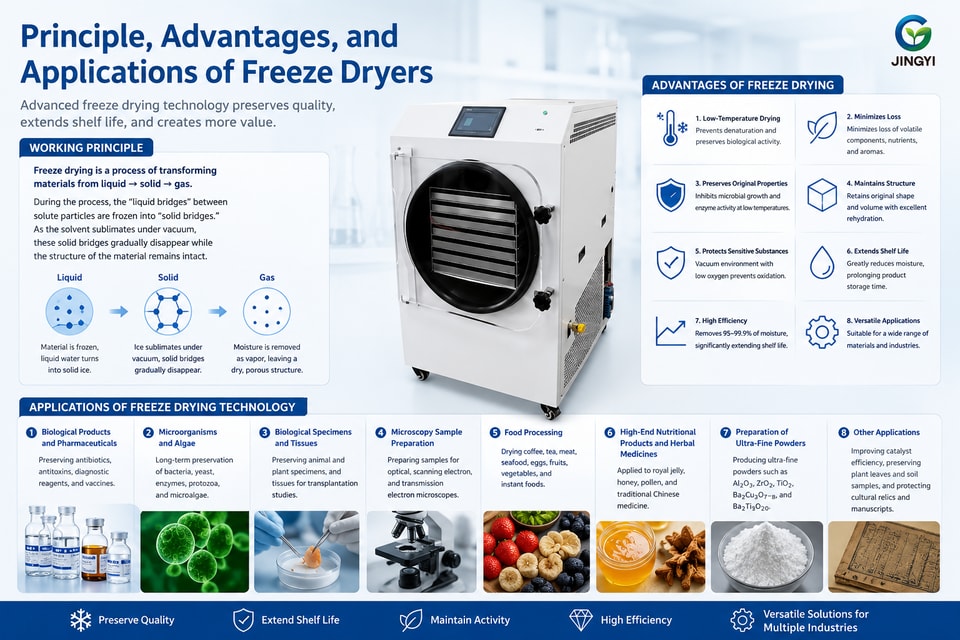
Principle, Advantages, and Applications of Freeze Dryers
First, let us understand the working principle of freeze drying. Freeze drying is a process of transforming materials from liquid → solid → gas. During the freeze-drying process, the “liquid bridges” between solute particles are frozen into “solid bridges.” The relative positions between particles become fixed, and there is no surface tension caused by gas-liquid interfaces between them. As the solvent continuously sublimates, the “solid bridges” gradually disappear, while the relative positions of the particles remain unchanged until the solid bridges vanish completely. 一.Advantages of Freeze Drying Compared with conventional drying methods such as sun drying, oven drying, boiling drying, spray drying, and vacuum drying, freeze drying offers the following advantages: 1. Drying is carried out at low temperatures, which prevents protein denaturation and preserves the biological activity of microorganisms. 2. Because of the low-temperature process, the loss of volatile components, heat-sensitive nutrients, and aromatic substances is minimized. 3. During low-temperature drying, microbial growth and enzyme activity are almost completely inhibited, allowing the material to maintain its original properties to the greatest extent. 4. After drying, the product retains its original volume and shape, with excellent rehydration performance. 5. Since the process is generally carried out under vacuum conditions with very little oxygen, oxidation-sensitive substances are effectively protected. 6. Freeze drying can remove 95–99.9% of the moisture in materials, significantly extending the product shelf life. 二.Applications of Freeze Drying Technology 1. Biological Products and PharmaceuticalsUsed for preserving antibiotics, antitoxins, diagnostic reagents, and vaccines. 2. Microorganisms and AlgaeSuitable for the long-term preservation of bacteria, yeast, enzymes, protozoa, and microalgae. 3. Biological Specimens and TissuesUsed for preparing and preserving animal and plant specimens, as well as tissues such as skin, corneas, bones, aortas, and heart valves for transplantation studies. 4. Microscopy Sample PreparationUsed for producing small tissue sections for optical microscopes, scanning electron microscopes, and transmission electron microscopes. 5. Food ProcessingWidely used for drying coffee, tea, meat, seafood, eggs, seaweed, fruits, vegetables, seasonings, tofu, and instant foods. 6. High-End Nutritional Products and Herbal MedicinesApplied to royal jelly, honey, pollen, and traditional Chinese medicine preparations. 7. Preparation of Ultra-Fine PowdersUsed in producing ultra-fine powders such as Al2O3, ZrO2, TiO2, Ba2Cu3O7–8, and Ba2Ti9O20. 8. Other Applications 1. Freeze-dried catalysts in the chemical industry can improve catalytic efficiency by 5–20 times. 2. Freeze drying is also used to preserve plant leaves and soil samples for agricultural research. 3. Water-damaged wooden artifacts, books, and manuscripts can be freeze-dried to preserve their original condition as much as possible.
read more
Application of Freeze Drying Technology in Dairy Product Preservation
As consumers increasingly demand healthier and higher-quality foods, freeze-dried dairy products are becoming more popular in the market. Compared with traditional hot-air drying, vacuum freeze drying technology better preserves the nutrition, texture, and flavor of dairy products. Therefore, it is widely used in products such as yogurt bites, cheese snacks, and milk powder. How Freeze Drying Works Freeze drying technology first freezes dairy products at low temperatures, then removes moisture through sublimation under a vacuum environment. Since the entire process takes place at low temperatures, heat-sensitive nutrients can be effectively preserved. Advantages of Freeze-Dried Dairy Products 1. Better Retention of Nutrition and Flavor The low-temperature drying process helps preserve: · Proteins · Vitamins · Probiotics · Natural dairy flavor Compared with conventional drying methods, freeze-dried products offer better taste and rehydration performance. 2. Extended Shelf Life After freeze drying, the moisture content is significantly reduced, effectively inhibiting bacterial growth. Under proper sealed packaging, freeze-dried dairy products can be stored at room temperature for 1–2 years. 3. Maintains Product Shape Freeze drying minimizes shrinkage and deformation during the drying process, helping dairy products maintain their original appearance and structure. Common Applications Freeze drying technology is widely used in: · Freeze-dried yogurt bites · Freeze-dried cheese · Probiotic dairy products · Infant dairy nutrition products · Pet dairy snacks Among them, freeze-dried yogurt snacks have experienced rapid market growth in recent years. Equipment Selection for Different Production Scales Small-Scale Production Suitable for: · Product development · E-commerce startups · Small food processing businesses Small freeze dryers such as the HFD and SFD series are ideal choices. Industrial Production Large dairy manufacturers usually require commercial or industrial freeze dryers featuring: · Large batch capacity · Automated control systems · Precise temperature control · Stable vacuum systems Freeze Drying Equipment Solutions Shanghai Jingyi Tech Co., Ltd. specializes in the development and manufacturing of vacuum freeze drying equipment and provides: · Equipment selection support · Freeze-drying process testing · Formula optimization · Complete production line solutions Its products have been exported to many countries worldwide. FAQ How long does freeze drying dairy products take? Typically, the process takes 12–30 hours, depending on the moisture content and thickness of the product. How should freeze-dried dairy products be stored? Vacuum bags or aluminum foil packaging are recommended to prevent moisture absorption. Which freeze dryer is suitable for dairy products? Small household or commercial freeze dryers are suitable for small-scale production, while industrial freeze dryers are recommended for large-scale manufacturing.
read more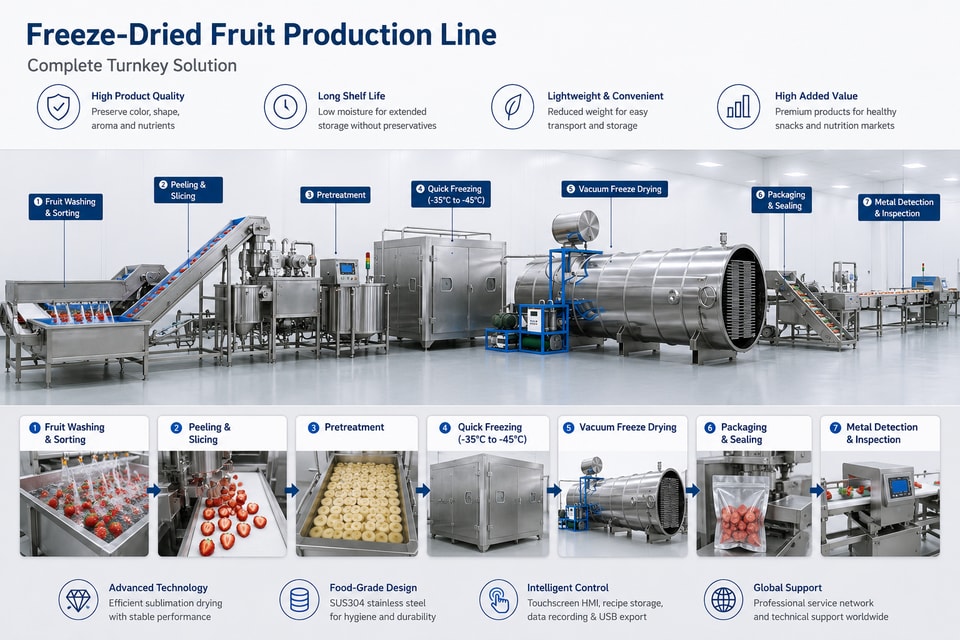
Complete Freeze-Dried Fruit Production Line Solution
Introduction Freeze-dried fruit has become one of the fastest-growing categories in the healthy snack and functional food market. Compared with traditional hot-air drying, freeze drying preserves the fruit’s original color, shape, aroma, nutrients, and taste while extending shelf life significantly. Vacuum freeze-drying technology removes moisture through low-temperature sublimation, helping fruits retain their natural structure and nutritional value. For manufacturers looking to enter or expand in the freeze-dried fruit industry, a complete production line is essential for achieving stable product quality, efficient operation, and scalable output. Shanghai Jingyi Tech Co., Ltd. specializes in intelligent vacuum freeze dryer systems and turnkey food processing solutions for global customers. What Is a Freeze-Dried Fruit Production Line? A freeze-dried fruit production line is a fully integrated system that processes fresh fruits into crispy, shelf-stable freeze-dried products through several controlled stages: 1. Fruit selection and washing 2. Peeling and slicing 3. Pre-treatment 4. Quick freezing 5. Vacuum freeze drying 6. Packaging and sealing 7. Final inspection and storage The core process is vacuum freeze drying, where frozen water inside the fruit sublimates directly into vapor under vacuum conditions. This process preserves biological and chemical properties while allowing long-term storage. Typical Freeze-Dried Fruit Production Process 1. Fruit Washing & Sorting Fresh fruits are cleaned to remove dirt, pesticide residue, and impurities. Defective or damaged fruits are removed to ensure product consistency. Suitable fruits include: · Strawberry · Mango · Banana · Apple · Blueberry · Pineapple · Dragon fruit · Peach · Raspberry · Durian 2. Cutting & Pretreatment Depending on the fruit type, peeling, slicing, dicing, or halving may be required. Pretreatment may include: · Color protection · Sugar concentration adjustment · Anti-oxidation treatment · Blanching for certain fruits Uniform slice thickness is critical because thicker materials require significantly longer freeze-drying times. 3. Quick Freezing The fruit is rapidly frozen below its eutectic point before entering the freeze dryer. Proper pre-freezing is one of the most important steps for achieving excellent drying performance and preventing collapse or bubbling. Typical freezing temperature: · -35°C to -45°C 4. Vacuum Freeze Drying The frozen fruit is transferred into the freeze dryer chamber. Under vacuum: · Ice sublimates directly into vapor · Moisture is captured by the cold trap · Product structure remains intact Typical freeze-drying duration for fruits: · 12–24 hours depending on moisture content and loading thickness 5. Packaging Freeze-dried fruits are highly hygroscopic and must be sealed immediately after drying. Recommended packaging: · Aluminum foil bags · Vacuum bags · Nitrogen-filled packaging Proper storage can maintain product stability for 1–2 years at room temperature. Advantages of Freeze-Dried Fruit Superior Product Quality Compared with conventional drying methods, freeze drying preserves: · Natural color · Crisp texture · Fruit aroma · Vitamins and nutrients · Original shape The process is especially suitable for heat-sensitive fruits. Long Shelf Life Low residual moisture allows long-term storage without preservatives. Lightweight & Easy Transportation After moisture removal: · Product weight decreases dramatically · Transportation cost is reduced · Export logistics become easier High Added Value Freeze-dried fruit products command premium pricing in: · Retail snacks · Healthy foods · Breakfast cereals · Yogurt toppings · Baby food · Functional nutrition Applications of Freeze-Dried Fruits Freeze-dried fruits are widely used in: Healthy Snack Industry Direct-consumption crispy fruit snacks Breakfast & Dairy Products Cereal toppings, yogurt mix-ins Beverage Industry Instant fruit tea and smoothie ingredients Bakery & Confectionery Chocolate inclusions, cake decoration Outdoor & Military Foods Lightweight emergency foods Functional Nutrition Nutrient-rich ingredient powders Small Scale vs Industrial Scale Production Small-Scale Startup Production Suitable for: · New businesses · Online snack brands · Farm product processing · Pilot production Recommended capacity: · 3–20 kg/batch Recommended models: · HFD Series · RFD Series · YFD Series The HFD series supports preset freeze-drying programs for fruits, vegetables, meat, and liquids, with additional customizable recipes. Example: · HFD-10: 10–12 kg/batch capacity Commercial & Industrial Production Suitable for: · Food factories · OEM manufacturing · Export processing plants · Large-scale snack production Recommended capacity: · 50–1000+ kg/day Recommended systems: · VFD Series · Large Production Freeze Dryer Systems The VFD commercial series offers: · Integrated vacuum system · Independent shelf temperature control · Remote monitoring · Automatic data recording · SUS304 food-grade trays and cold traps Example capacities: · VFD-10: 10–15 kg/batch · VFD-50: 60–75 kg/batch Complete Equipment Configuration A complete freeze-dried fruit production line may include: Equipment Function Fruit Washing Machine Cleaning Peeling/Slicing Machine Fruit preparation Blanching Machine Pretreatment Quick Freezer Rapid freezing Vacuum Freeze Dryer Core drying process Vacuum Pump System Create vacuum environment Cold Trap System Capture sublimated moisture Air Compressor Pneumatic support Vacuum Packaging Machine Final sealing Metal Detector Food safety inspection Why Choose Jingyi Freeze Drying Solutions? Shanghai Jingyi Tech Co., Ltd. provides one-stop freeze-drying solutions including: · Freeze dryers · Quick freezing systems · Pretreatment equipment · Vacuum packaging systems · Turnkey food processing projects Key Advantages Advanced Freeze-Drying Technology · High vacuum performance · Stable refrigeration · Efficient sublimation drying Food-Grade Design · SUS304 stainless steel trays and cold traps · Easy cleaning and sanitation Intelligent Control System · Touchscreen HMI · Recipe storage · Automatic data recording · USB export function Global Export Experience Products exported to over 100 countries including: · USA · Germany · UK · UAE · Malaysia · Indonesia Pilot Testing Support Jingyi provides pilot-scale testing laboratories for freeze-drying verification of various materials. Frequently Asked Questions How long does freeze-drying fruit take? Typically 12–24 hours depending on fruit type, moisture content, thickness, and batch loading. What fruits are suitable for freeze drying? Most fruits can be freeze dried, including: · Strawberry · Mango · Banana · Apple · Blueberry · Pineapple · Dragon fruit Does freeze drying preserve nutrition? Yes. Freeze drying preserves nutrients, color, aroma, and natural structure much better than traditional hot-air drying. How should freeze-dried fruits be stored? Store products in sealed moisture-proof packaging such as aluminum foil bags or vacuum bags. Can the production line be customized? Yes. Equipment can be customized according to: · Fruit type · Production capacity · Factory layout · Automation level · Utility requirements Start Your Freeze-Dried Fruit Business Today Whether you are launching a small freeze-dried snack brand or building a large industrial fruit processing factory, Jingyi can provide: · Equipment selection · Freeze-drying process design · Pilot testing · Factory planning · Installation & training · Long-term technical support Contact Shanghai Jingyi Tech Co., Ltd. today to get a customized freeze-dried fruit production line solution tailored to your production goals.
read moreContact US
Product Information

Quantity
Unit
Piece
Support order samples, customization, wholesale direct, and complete payment. If the product you look for does not have corresponding customized content, pls fill out the form below to contact us, and we will reply ASAP.